Most buyers ask the same three things. Which accreditations do you actually hold? How are your officers screened and vetted? And does the standard hold once the contract starts? This page answers all three, and then shows you three sites where it was tested.
Accreditation logos are easy to put on a website. Here is what sits behind each of ours, and why it matters when you are the one signing the contract.
The Security Industry Authority's approval scheme. It is independently audited every year against standards covering service delivery, personnel and management, so the way we run the business is checked by someone other than us. Main contractors and public sector buyers ask for it by name.
A health and safety accreditation covering our policy, risk assessments, method statements and training records. It means our paperwork is already in order when your principal contractor asks for it, rather than being written the week before you need it.
The British Standard for keyholding and response. It sets out how keys are held, how calls are handled and how officers attend, so your alarm response follows a published standard rather than local habit.
The British Standard for security screening and vetting of staff. It defines the checks a security employer must complete before an officer is placed on a site. Every NVC officer is screened to it.
Cover is in place and certificates are available on request, so your insurer and your risk team can tick the box before we set foot on site.
A control room staffed around the clock. When an alarm activates or an officer needs backing up at three in the morning, there is a trained operator on the other end, around the clock.
The officer at your gate is the whole service as far as your staff and your neighbours are concerned. We take the selection of that person seriously and we can show our working.
Site-specific training is the part people skip. An officer who has been walked round the site, introduced to your team and briefed on what normal looks like will spot the thing that is not normal. One who was sent an address the night before will not.
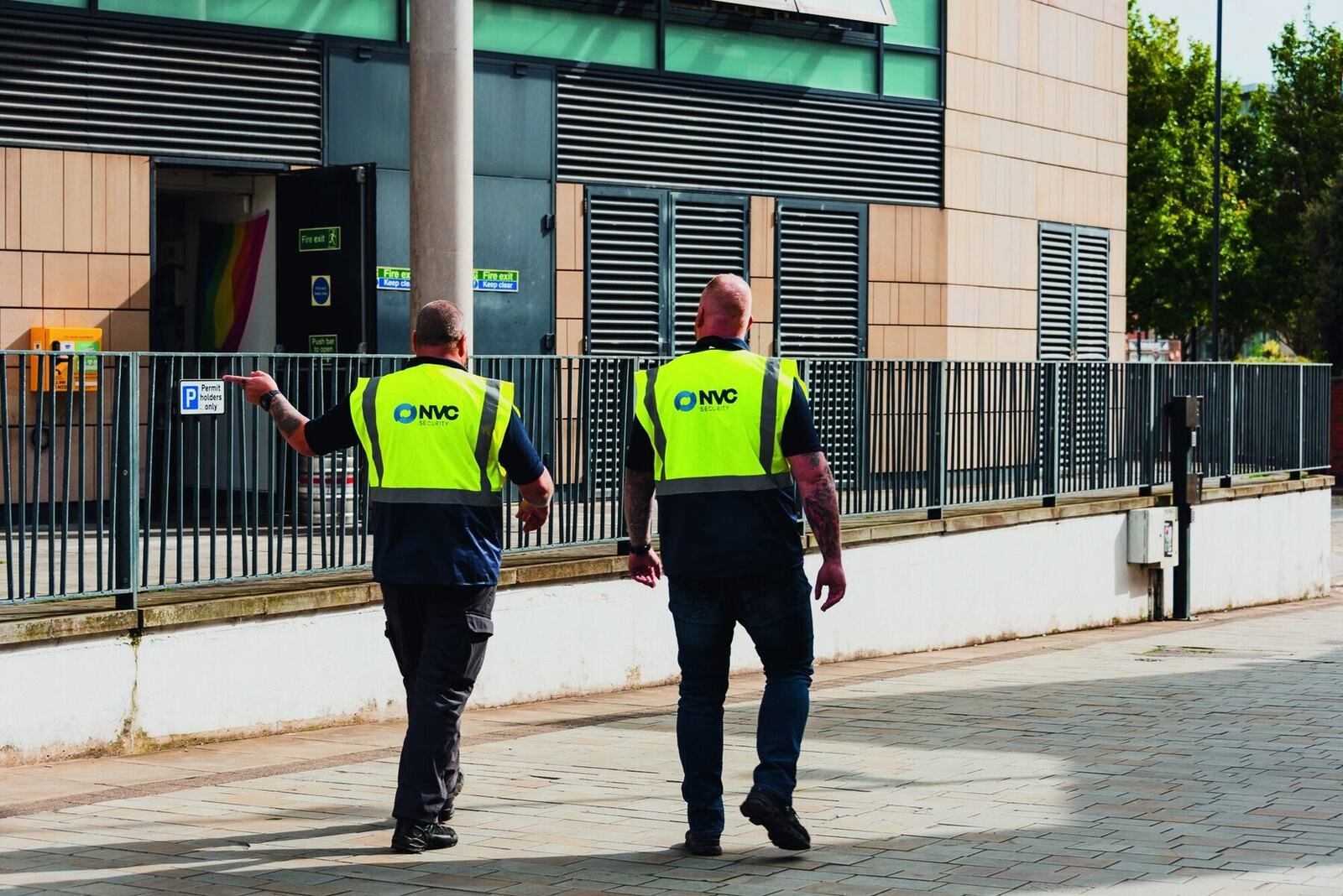
No dramatics, no rounded-up numbers. These are jobs we ran, what we found and what happened next.
Client: Clowes Developments (named with permission)
Two large vacant plots of land with a drainage and underground network running between them. People were breaking in on motorbikes across the levelled ground. During a routine fortnightly inspection our team found a manhole cover open with ladders left in it. Below was a tunnel network running roughly 300 metres under an adjacent building and surfacing on the next plot, with several offshoots. Nobody knew whether anyone was still down there.
A specialist confined-space team searched the network by drone and confirmed it was clear. We then put a dog handler on site: 24/7 for the first month, scaled to evenings and weekends, then three weeknights plus Saturday and Sunday days. Alongside that we installed two solar-powered CCTV towers, one per plot, and sensors on the eight to nine manhole covers giving access to the network.
The intruders on bikes stopped coming once they saw the dog units. There were no further incidents. Manned cover was scaled down month by month as the technology took over, so the client's cost came down over time rather than staying flat.
Client: a vacant residential site in Derby
Six blocks of vacant flats in a difficult part of Derby, on a site with a history of trouble.
A battery-powered vacant property alarm system in each block, self-monitoring and reporting in daily to confirm it was live, plus a weekly patrol.
Six to seven months passed with nothing. Then one block activated and the cameras showed people inside. Our control room called it in as a crime in progress with a request for a discreet approach rather than lights and sirens. Further activations tracked the intruders through the building, police attended and detained them, and our response officer arrived to secure the site. The quiet months were the system working. It was there on the night it mattered.
Client: a vacant former mill in Chesterfield
A vacant former mill with repeated break-ins and no mains power.
Battery-powered monitored detection with AI image grading, with the detection confidence threshold tuned to the site.
Intruders were picked up and dealt with. The image quality was good enough that the equipment manufacturer asked us for permission to use the capture as an example of the system working.
NVC has been protecting property across the East Midlands since 2013, run by a management team with over 40 years of combined experience. We have offices in Derby and Leicester, a 24/7 control room and our own response fleet.
If you want to see how that translates into a service on your site, start with a conversation. Read more about NVC or see who we already work for.





Tell us the address, the hours and what is worrying you. We will come back the same working day with a plan and a price.
Talk to us about your site 01332 806996